Rehab Valuator Budget & Cost Template Updates
2026 Construction Pricing Trends and Adjustments
Track the market. Protect your margins. Build smarter.
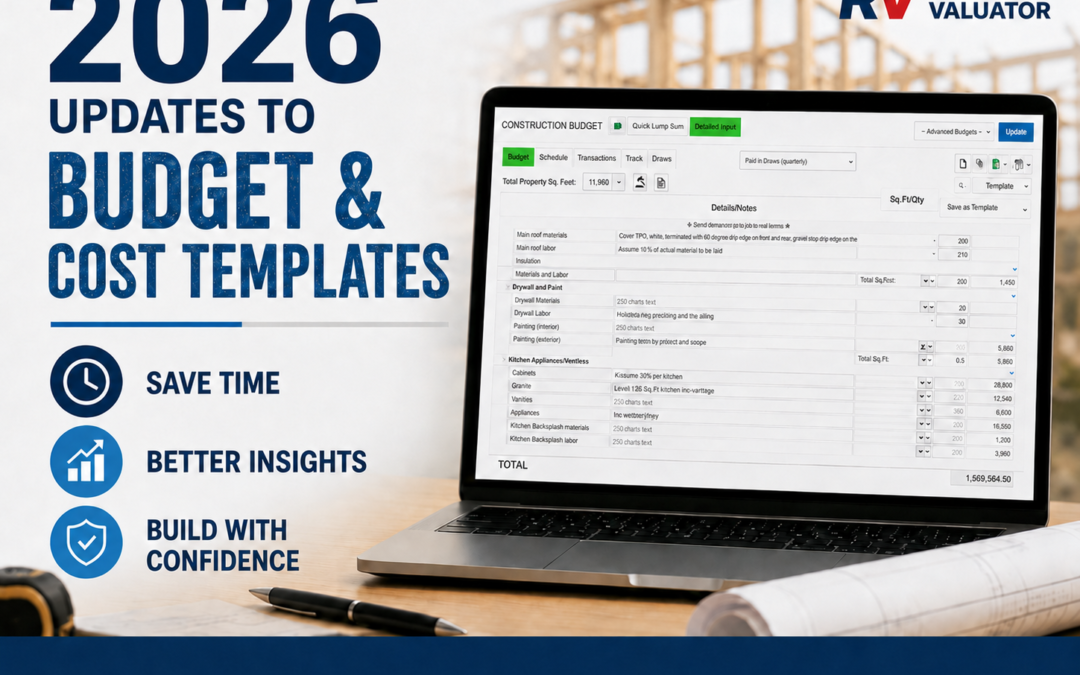
Construction and Rehab Costs never stand still — and if you’re not updating your budgets, you’re already behind. That’s why Rehab Valuator’s Premium software includes built-in budget and cost templates that we regularly update to reflect real-world pricing trends.
Our 2026 updates are here.
Track the market. Protect your margins. Build smarter.
Construction and Rehab Costs never stand still — and if you’re not updating your budgets, you’re already behind. That’s why Rehab Valuator’s Premium software includes built-in budget and cost templates that we regularly update to reflect real-world pricing trends.
Our 2026 updates are here.
What’s Changed in 2026?
We’ve made a fresh round of updates to Rehab Valuator’s budget templates to help you build more accurate budgets, scopes, and schedules for your real estate investing and development projects.
These updates are based on what we’re seeing in real projects, contractor pricing, supplier feedback, and active conversations with investors and developers using the software in the field.
As always, these templates are meant to give you a strong starting point and should be adjusted for your specific market and specific deal.
Here’s what we’re seeing this year:
- More real-world detail added: This year’s updates go beyond simple price changes. We added and refined line items that are easy to overlook but show up in real projects, including staging, interior design, cleaning, contingency, miscellaneous work, punch-out, and final grading.
- Roofing has increased: Roofing has moved up slightly, so we increased the roofing allowances in the templates to better reflect what we’re seeing in current projects.
- Insulation is now more dialed in: Insulation and vapor barrier pricing has been one of those areas we’ve been tracking closely. At this point, we feel more comfortable using $3 per square foot as a realistic starting point in our market.
- Exterior doors have gone up: Windows have stayed fairly consistent, but exterior doors have increased. We updated the template allowances to better reflect that.
- MEPs are holding relatively steady: Plumbing, HVAC, and electrical have stayed fairly consistent compared to prior updates, but the templates still give you a detailed place to budget and adjust these items based on your specific project and local pricing.
- Interior paint was adjusted: Interior paint was bumped up to better reflect what we’re seeing from subcontractors. Of course, if your painter is coming in lower in your market, you can adjust that line item inside your own template.
- Fixtures and appliances were cleaned up: We combined plumbing and electrical fixtures into one cleaner line item, since that is how many projects are often purchased and managed in the field. Appliance allowances were also updated to better account for full packages, including items like hoods and related pieces that can quickly add up.
- More built-in cushion: We added contingency and punch/miscellaneous line items because these are the types of costs that can easily get missed. Whether you use a small number or a larger number, the important thing is that you are thinking about it before the project starts.
Updated Templates Included in Premium
Our 2026 update refreshes multiple templates, including:
- New Construction – Single Family
- Full Gut Renovation with Addition
- Full Gut Renovation
- Cosmetic Renovation
Each template is a complete roadmap, not just a budget. Inside the templates, you’ll find:
- Detailed scopes of work
- Pre-built cost categories and line items
- Updated allowances based on current project data
- Integrated project schedules
- Line items you can adjust for your own market and project type
Why This Matters for Your Business
Underestimating costs is one of the fastest ways to lose money in real estate investing and development.
The goal of these updates is to help you start with a more realistic budget from day one so you can:
- Accurately forecast total project costs
- Build stronger scopes of work
- Adjust pricing to match your local market
- Avoid missing common line items
- Keep your project organized from budget to schedule