
House Flipping Software
Analyze, Estimate, Manage and Fund Every Flip in One Platform
Run the comps, calculate your max offer, budget the rehab, schedule the work, and generate the lender presentation — without leaving one platform or maintaining a single spreadsheet. Start free.
Why Choose Rehab Valuator for House Flipping?
One platform for the entire flip, not one piece of it.
House flipping software helps investors analyze potential flips, estimate rehab costs, manage the renovation, and secure funding — replacing the spreadsheets and disconnected tools most flippers juggle. Rehab Valuator covers all four in one place, from the first comp you pull to the check you cash at closing.
Most software for flipping houses does one job well: a rehab estimator here, a lead-gen app there, a lender report generator somewhere else. Rehab Valuator is the platform flippers use start to finish — and the Lite plan is free forever.

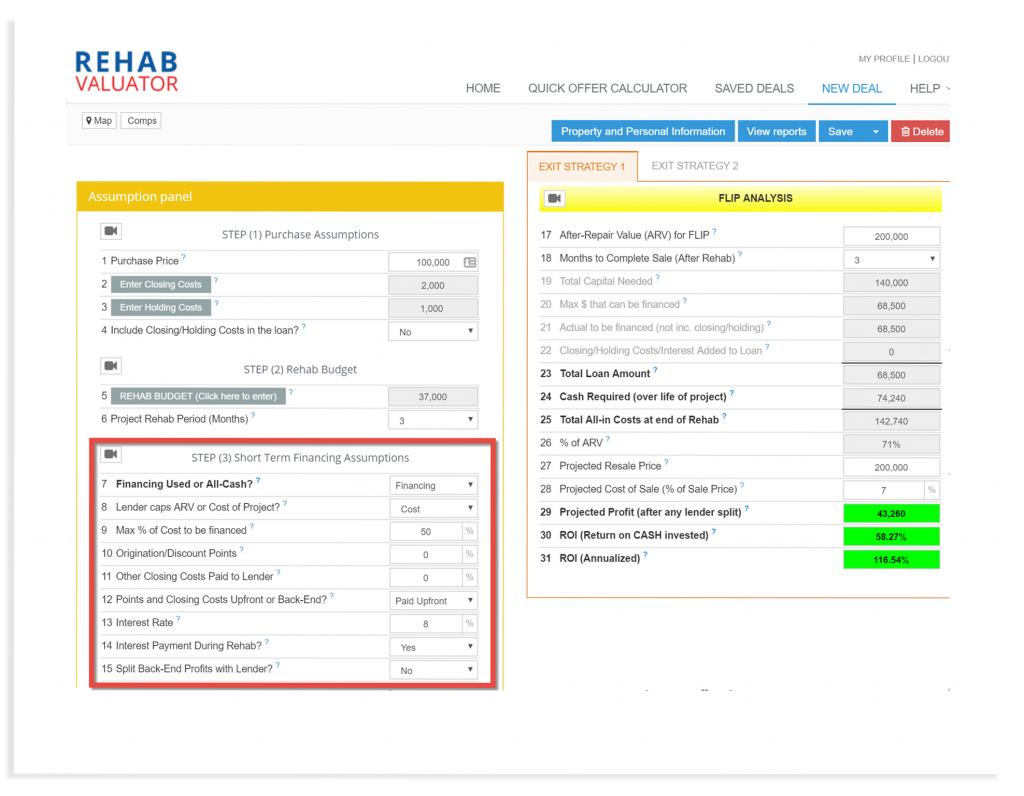
Analyze Any Flip in Minutes
Enter an address, get the whole picture. Property characteristics, owner and mailing address, last sale, assessment, and mortgage details — instantly, anywhere in the US.
- Instant ARV: Pull the 25 most relevant sales comps and let the software calculate ARV automatically
- Never Overpay: The Max Offer Calculator gives you your maximum allowable offer (MAO) before you make it
- Instant Profit Math: See projected profit and ROI the moment your numbers change — fix and flip deal analysis in minutes, not evenings
Know Your Cost of Money Before You Commit
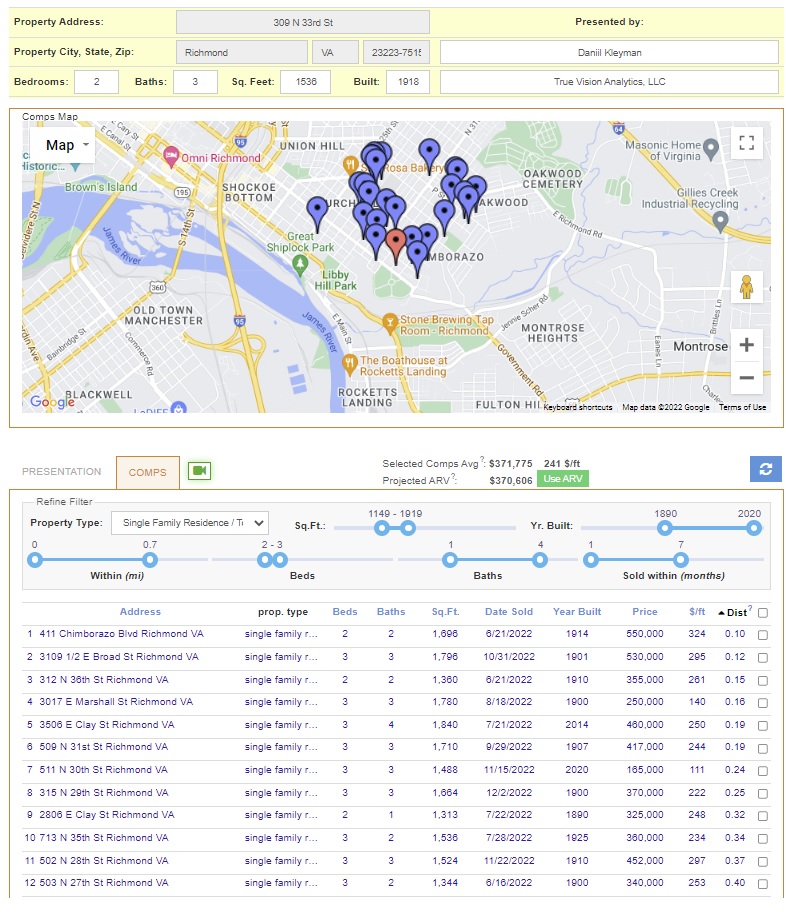
- Model every financing option side by side — Cash, Bank Loan, Private Lender, or Hard Money
- See profit after the cost of money, not before — the number that actually lands in your pocket
- Compare scenarios in seconds and walk into the lender conversation knowing which structure works
Know Your Cost of Money Before You Commit
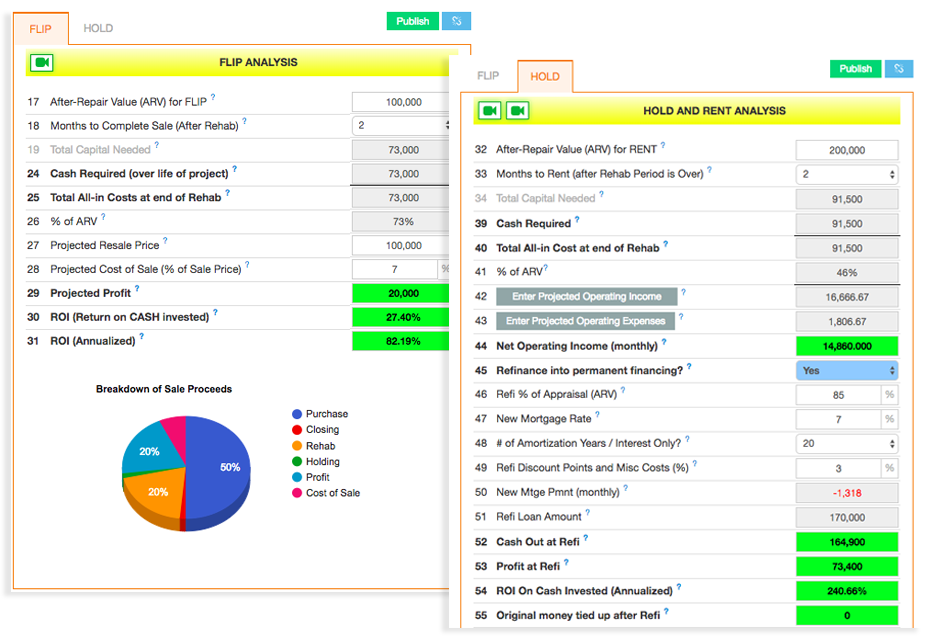
- Model every financing option side by side — Cash, Bank Loan, Private Lender, or Hard Money
- See profit after the cost of money, not before — the number that actually lands in your pocket
- Compare scenarios in seconds and walk into the lender conversation knowing which structure works
Estimate Rehab Costs Without Guesswork
Your profit is decided by the budget, not the purchase price. The built-in rehab cost estimator gets you to an accurate number fast:
- Start from pre-built cost templates instead of a blank spreadsheet
- Save your own reusable templates — every future flip starts faster
- Generate scope of work sheets to print or email to contractors
- Track bids, contractor info, and notes in one place

Manage the Flip From Demo Day to Sale
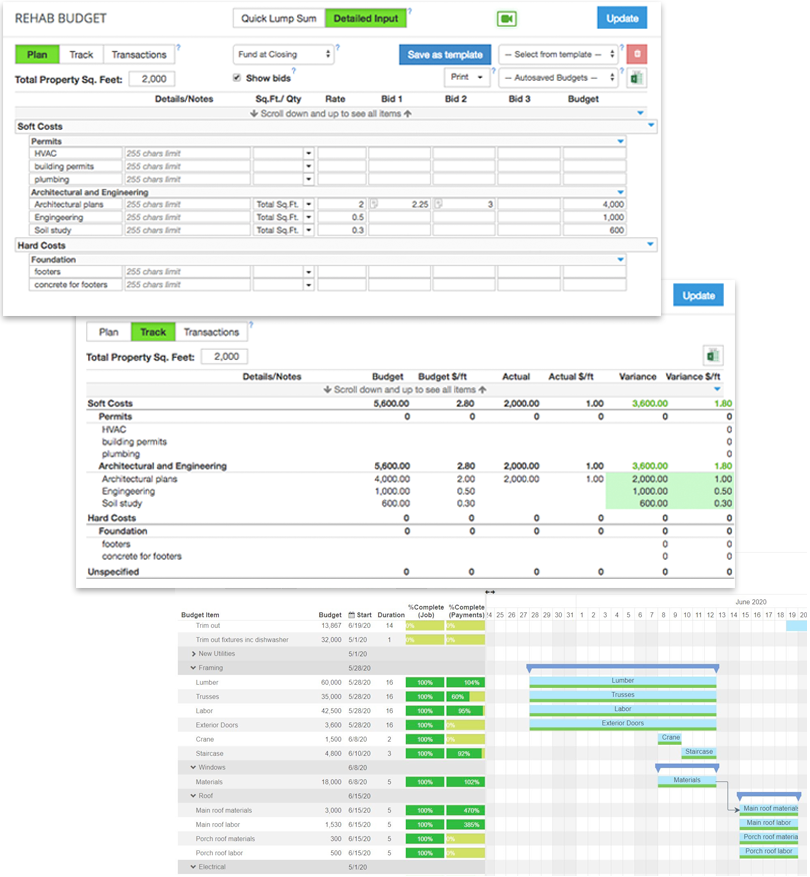
Deal analyzers stop at closing. Built-in house flipping project management keeps working through the renovation:
- Drag-and-drop project scheduler to map the whole timeline
- Transactions link to your Track Screen — always know if you’re on, under, or over budget
- Mini-accounting system for each project, so you skip the bookkeeper
- Lender draws generated as AIA-compliant PDFs to send for reimbursement
Get Your Flip Funded
One-click funding presentations: Cover page, executive summary, and full deal breakdown that answer your lender’s questions before they’re asked
1-page funding proposals: Show private and hard money lenders exactly what’s in it for them

"I've used the software for several refi's and they all went super smooth with help from the software. I highly recommend it if you're doing anything even moderately serious in real estate."
"This product is hands down the best rehab calculation tool out there. If you are serious about flipping, investing, raising private money, building, etc you would be a fool not to use this."
"Rehab valuator is a superb company and worth every penny! Not only are they extremely knowledgeable and provide massive value to their members, they also have exceedingly high levels of integrity."
Who This House Flipping Software Is Built For
Active flippers running 1 to 20 deals a year who need speed and accuracy on every analysis
Investors leaving spreadsheets behind who want templates, tracking, and reports in one system
Flippers using private or hard money who need lender-ready presentations and draw requests
Wholesalers who also flip — same platform, both exit strategies
Flipping your first house? Start with our software and education for new flippers. Keeping the property instead of selling? Run it as a BRRRR deal.
Everything Else You Need to Know About House Flipping Software
How to choose the best house flipping software
Every flipping tool on the market claims to do the same four things, and almost none of them do all four. Understanding where each one actually stops is the fastest way to figure out which one belongs in your business.
The first question is whether the software analyzes deals or merely stores them. There is a real difference between a calculator that does arithmetic on numbers you typed in and a platform that pulls property records, retrieves comparable sales, and computes after repair value on its own. If you are still opening a separate tab to research comps and then copying figures across, the software is not doing the analysis — you are, and the tool is just holding the result. The distinction matters most under time pressure, which is exactly when flippers make offers.
The second question is what happens to your rehab budget. Cost estimating is where deals are won and lost, and it is also the most tedious part of the job. Software that ships with cost templates, and lets you save your own after each project, compounds in value: your tenth flip is budgeted from the accumulated knowledge of the nine before it. Software without templates makes you start from a blank sheet every time, which is how line items get forgotten and margins disappear.
Third, look at what happens after closing. Most tools in this category are deal analyzers — they help you decide whether to buy, then go quiet. But overruns do not happen at the closing table. They happen in month two, when the plumbing bid comes in higher than budgeted and nobody notices until the money is gone. A platform that carries scheduling, transaction logging, and live actual-versus-budget tracking through the renovation is doing the part of the job where the profit is actually protected.
Fourth, consider your lenders. If you fund deals with private or hard money, the quality of your presentation affects both whether you get funded and what terms you get. Software that generates a complete funding presentation — cover page, executive summary, deal breakdown, photos — puts you in a different category than the investor emailing a spreadsheet screenshot. The same applies during construction: if the platform generates draw requests, you stop rebuilding that document in Excel every month.
Finally, weigh the data and the pricing model together. Property records, owner information, sales comps, and rental comps are often sold as separate subscriptions by separate vendors. Getting them inside the same tool you already pay for is usually a better deal than assembling a stack. And pricing should match how you actually work: month to month, no annual contract, and ideally a free tier so you can run a real deal through the software before you spend anything.
Rehab Valuator was built to cover all five areas in one subscription, and the Lite plan is free forever, so the evaluation costs you nothing but the time to analyze one deal.
House flipping software vs. spreadsheets: when to make the switch
Nearly every flipper starts in a spreadsheet, and for the first deal or two that is a reasonable choice. The spreadsheet is free, it is familiar, and it does exactly what you tell it. The problem is that it keeps doing exactly what you tell it, including the things you told it by accident.
Spreadsheet errors are quiet. A formula that references the wrong cell does not throw a warning; it just returns a number that looks plausible. Flippers have bought houses on the strength of a total that was missing a holding cost row. By the time the mistake surfaces, the money is spent. Purpose-built software fixes the calculations in place, which means the arithmetic is the one thing you no longer have to audit.
Then there is the maintenance cost, which most people underestimate because it is paid in evenings rather than dollars. Every deal means rebuilding the budget, re-researching comps, re-formatting the lender package, and re-saving a file with a name like “123-Main-final-v3-REAL.xlsx.” At one flip a year, that is tolerable. At two or more, it is a part-time job that produces nothing.
Here is the practical comparison:
| Spreadsheet | Rehab Valuator | |
|---|---|---|
| Comps and ARV | Manual research, copied by hand | 25 comparable sales pulled by address, ARV calculated |
| Rehab budget | Rebuilt from scratch every deal | Pre-built templates plus your own reusable ones |
| Formula errors | Silent and expensive | Calculations fixed and tested |
| Project tracking | A second file, usually abandoned by week three | Schedule, transactions, live actual vs. budget |
| Lender package | Manual formatting, inconsistent results | One-click funding presentation |
| Version control | Filenames ending in “final_REAL_v3” | One live deal, always current |
The switching point is usually deal flow. If you flip one house a year, the spreadsheet survives. Once you are running two or more, or managing overlapping projects, the maintenance costs more than the software does — and the errors cost more than both.
How a flip actually runs inside Rehab Valuator
It helps to see the whole sequence, because the value of an all-in-one platform is not in any single feature. It is in the fact that the work carries forward instead of being re-entered.
Before you make an offer, you start with an address. The software returns property characteristics, owner and mailing address, last sale, assessment, and mortgage information, then pulls the 25 most relevant comparable sales and calculates after repair value automatically. From there the Max Offer Calculator works backward from your target cost basis to tell you the most you can pay. This is the step that prevents the single most expensive mistake in flipping, which is falling in love with a property and reverse-engineering the numbers to justify it.
Before you close, you build the rehab budget. Loading a cost template gets you most of the way there in minutes, and you adjust line items to match the actual property. That budget produces a scope of work you can print or email to contractors, and their bids come back against your line items rather than as lump sums you cannot evaluate. If the budget kills the deal at this stage, you have saved yourself a renovation.
Then you structure the money. Model the purchase as cash, bank loan, private lender, or hard money and compare the outcomes side by side. Financing is not a footnote in a flip; points and interest across a six-month hold can consume a meaningful share of the profit. Seeing profit after the cost of money is the number that matters.
When you need funding, the deal you have already built becomes the presentation. One click produces the full funding package, or a one-page proposal if that is what your lender prefers. Nothing is retyped, which means nothing is inconsistent between what you analyzed and what the lender sees.
Through the renovation, the project management side takes over. Schedule the trades with drag-and-drop, log transactions as they occur, and watch actual versus budget update in real time. When a category starts drifting, you find out while it is still a line item rather than at the end when it is a loss. If you are on a rehab or construction loan, draw requests generate as AIA-compliant PDFs from the same budget you have been tracking all along.
At the sale, the post-project summary tells you what really happened versus what you projected — and those actual costs become the template for the next flip, which is how estimating accuracy improves over time instead of resetting with every deal.
House flipping terms every investor should know
ARV (After Repair Value)
What the property will be worth once the renovation is complete, based on comparable sales of similar finished homes in the same area. Every other number in a flip derives from this one, which is why sloppy comp selection is the most common way a deal goes wrong before it starts.
MAO (Maximum Allowable Offer)
The most you can pay for the property and still hit your target profit after rehab costs, holding costs, financing, and selling costs. Knowing your MAO before you negotiate is the difference between walking away from a bad deal and talking yourself into one.
Cost of money
What your financing actually costs over the life of the project — points, interest, and fees combined. A deal that works comfortably with cash can fail on hard money at the same purchase price, which is why financing has to be modeled and not assumed.
Scope of work
The itemized list of everything to be done in the renovation, priced line by line. It is what you send contractors so their bids are comparable, and it is your defense against change-order creep once the work is underway.
Lender draw
Rehab and construction loans are not funded up front. The lender releases money in stages as work is completed: you submit a draw request showing the percentage complete for each line item, an inspector verifies it, and the funds are released. Generating those requests quickly and accurately keeps your subcontractors paid and your project moving.
Get Started Today
Don’t leave your next deal to guesswork. Equip yourself with the tools flippers use to buy right, stay on budget, and get funded.
Haven’t Tried Rehab Valuator Premium Yet?
"Most recently I started on my first development project, a 27 unit $4.2M project and I used the RV software exclusively to create the presentation to raise the funds. RehabValuator has been a game changer in my business."
"It has transformed my rehabbing and development business. It saves me hours on project management, provides important data and insights, and increases my accuracy tremendously. I consider this software a necessity for anyone looking to build at the highest level!"
"I've used the program to raise millions of dollars for my wholesale, flipping and holding programs... Since I learned about this program I've built over 10 homes, I've developed a 17 lot subdivision and have other new build STRs on the way."